BasiGo – Practical Action
About
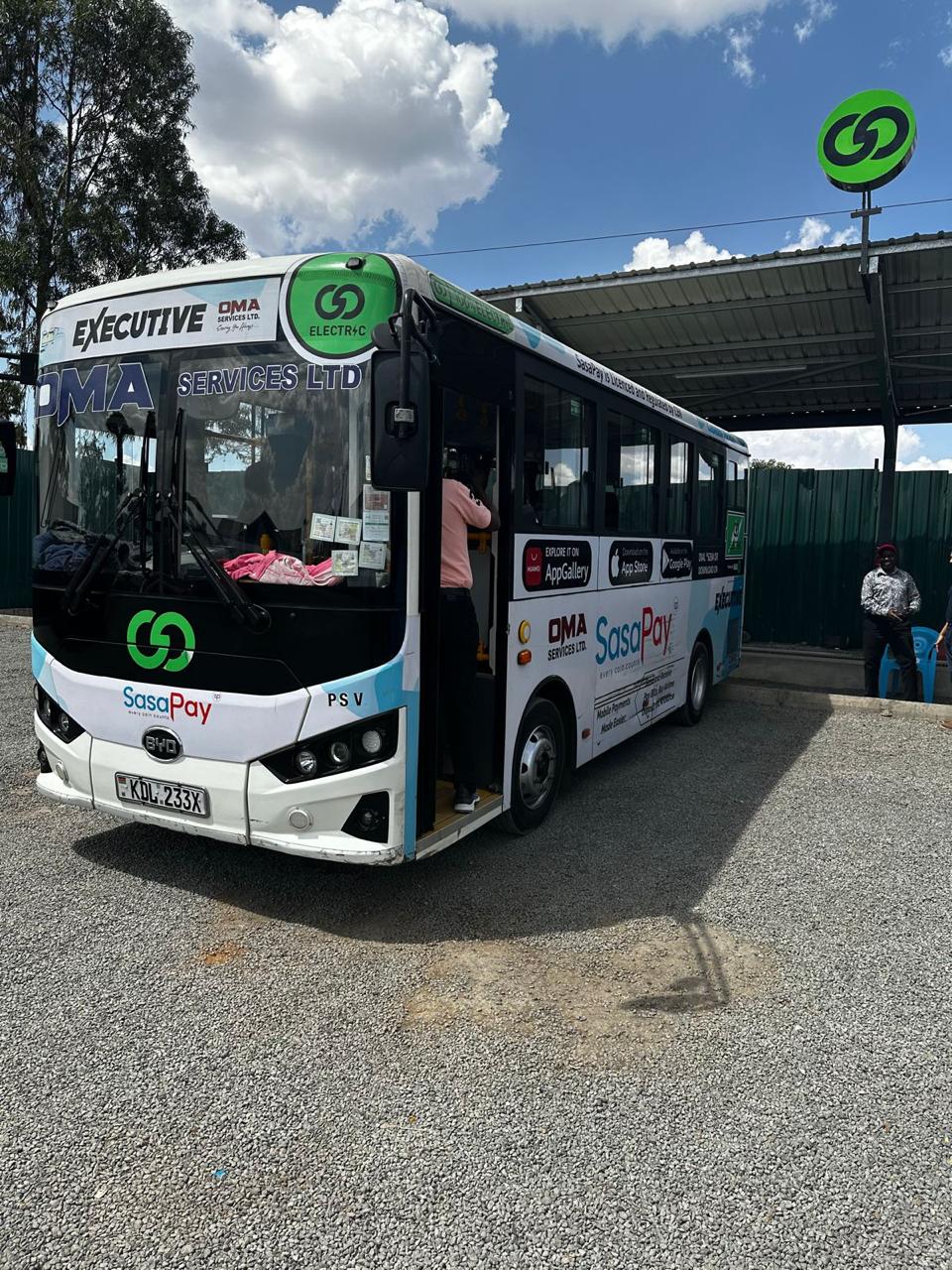
The BasiGo – Practical Action partnership accelerated the transition to electric mobility in Kenya and the rest of sub-Saharan Africa (SSA) through a solution that integrates e-bus sourcing, charging & service infrastructure & expertise, and Pay-As-You-Drive (PAYD) financing. This multipronged solution addressed the barriers of e-bus adoption in SSA, allowing public bus operators to benefit from an e-bus’s lower total cost of ownership and reduced operational costs compared to internal combustion engine buses. =
Investing in Impact
P4G awarded the partnership with about US $348,000 in grant funding.
BasiGo’s PAYD leasing model sets it apart from other e-bus players. This subscription-based model allows public bus operators to purchase an e-bus and pay a per-kilometer fee to lease the battery, charge and service the bus. This will lower the high upfront costs of ownership.
In this approach, bus operators lease e-buses by i) paying a security deposit that is affordable, and ii) paying an affordable per km lease fee that covers all the e-buses charging and service requirements. This fee is less than what owners currently pay for the financing charges, fuel and maintenance of diesel buses. It allows them to improve their internal rate of return and monthly net income.
BasiGo’s mission is to create the future of clean, electric public transport in Africa. It does this through an innovative financing and infrastructure deployment model that removes the capital constraints, and behavior change barriers to electric vehicle adoption in Nairobi, Kenya and the rest of SSA. BasiGo will ensure that environmental and social considerations are put at the forefront of its operations from its supply chain to customer onboarding and asset removal. By doing so, the partnership believes that it can increase its environmental and social impact, raise more capital, and accelerate the transition to green mobility in SSA.
The nature of the business model presents inherent Environment and Social (E&S) risks ranging from supply chain issues concerning materials sourcing and labor conditions in the production of e-buses, to road safety concerns during their operation that need to be measured and mitigated.
During the P4G funding period, BasiGo and Practical Action launched the MOBESSA project to strengthen environmental, social and governance practices in Kenya’s e-mobility sector while supporting a more enabling policy and regulatory environment. The partnership combined BasiGo’s operational experience in electric public transport with Practical Action’s expertise in environmental and social governance, stakeholder engagement and sector learning. Together, they developed and embedded an Environmental and Social Management System within BasiGo’s operations, translated the lessons into a practical sector-wide ESMS toolkit, and convened government, industry and development partners to advance standards, policy dialogue and county-level planning for e-mobility.
Practical Action brought deep expertise in environment and social governance and supported the partnership in establishing the ESMS system compliant with international standards and local regulations. The nonprofit also developed and disseminated best practices to empower other e-mobility businesses in the region. Additionally, it led on industry and stakeholder engagements.
The activity moved from enterprise-level ESG improvement to wider market transformation. At company level, BasiGo established systems for managing environmental and social risks across its workforce, suppliers, depots and battery lifecycle. At sector level, Practical Action and BasiGo worked with the E-Mobility Association of Kenya, regulators and private companies to validate ESG tools that can be adapted by e-mobility businesses of different sizes and sub-sectors. The partnership also supported policy and technical discussions with national institutions and county governments, helping connect private-sector innovation with public-sector planning, safety standards and infrastructure readiness.
The project’s main value was its integrated approach: it did not treat ESG as a compliance exercise alone, but as a foundation for investment readiness, operational resilience and responsible market growth. By documenting BasiGo’s experience and turning it into shared tools and knowledge products, MOBESSA created practical resources for the wider e-mobility ecosystem while positioning Kenya as a leader in standards-based, inclusive and sustainable electric transport.
Key achievements
- Developed and institutionalized BasiGo’s Environmental and Social Management System, aligned with international best practice and integrated into company operations, supplier management and reporting.
- Established dedicated ESG capacity within BasiGo, including policies and tools for supplier compliance, grievance handling, road safety, gender safeguards and battery recycling.
- Created and validated Kenya’s first sector-wide ESMS toolkit for e-mobility companies, providing adaptable guidance for businesses across electric buses, two- and three-wheelers, charging infrastructure and related services.
- Engaged more than 230 stakeholders, including county governments, regulators, utilities, private companies and civil society actors, through workshops, policy dialogues and technical consultations.
- Contributed to national and county-level e-mobility policy processes, including input to Kenya’s EV charging standards and recommendations for integrating e-mobility into county energy, climate and transport planning.
BasiGo also launched a Road Safety Project with Norfund, drafted the project terms of reference, and completed a data collection trial that informed its now-finalized ESMS, setting the foundation for implementation.
BasiGo hired an ESG manager to lead ESMS data collection and monitoring, with plans to expand the team in the coming quarters. To strengthen battery lifecycle management, the company joined the Kenya E-Mobility Battery Initiative and participated in a related Africa E-Mobility Alliance workshop.
BasiGo submitted a memorandum to the E-Mobility Taskforce, drawing on 11 months of electric bus operations in Nairobi to inform Kenya’s national e-mobility policy. Its input was cited in the Taskforce’s interim report, and the company will continue supporting policy development.
BasiGo and other e-mobility stakeholders in Kenya also advocated for an inclusive tariff structure in a memorandum to Kenya Power Ltd. The resulting tariffs introduced favorable Time-of-Use rates and removed demand charges, although usage is capped at 15,000 kWh per month. These changes are expected to improve the competitiveness of e-mobility by reducing domestic electricity costs by up to 22%.
As part of engaging government ministries to share policy recommendations and progress updates, BasiGo hosted officials from the Ministry of Investment, Trade, and Industry at its local electric bus assembly plant to showcase its progress and discuss potential government support for the sector. Practical Action co-sponsored an E-Mobility Open Day that convened government officials, regulators and private companies. The event featured EV exhibitions and a plenary session highlighting insights from the MOBESSA project.
BasiGo’s leadership was further recognized when it was named “Best Green Tech Startup” at the Global Startup Awards Grand Finale.
During the P4G funding period, BasiGo aimed to raise US $39 million to scale its operations. It succeeded in securing US $42 million in funding, completed 5.9 million passenger trips and created more than 300 green jobs. It delivered 17 buses in Nairobi and plans to deploy 1,000 e-buses across sub-Saharan African cities, avoiding over 2,900 metric tons of carbon emissions. The partnership also produced a case study “Scaling Electric Public Transport in Africa: A BasiGo Case Study” and white paper “Scaling Electric Mobility Across Kenyan Counties – A Case Of Nairobi, Mombasa And Kisumu Counties” detailing its efforts.
Lessons learned
- Embedding ESG systems early helps e-mobility businesses improve governance, reduce operational risks and strengthen investor confidence.
- Practical tools are most useful when they are adaptable to companies of different sizes, maturity levels and business models.
- Strong partnerships between businesses, NGOs, industry associations and government can accelerate the adoption of responsible practices across an emerging sector.
- Sustained engagement with national and county governments is essential for turning e-mobility innovation into supportive policies, standards and infrastructure planning.
- Enterprise-level learning has greater impact when it is documented, shared and converted into sector-wide guidance that others can use.
The partnership comprised the following partners: BasiGo (lead business partner); Practical Action (lead administrative partner).
Partners