Crustea – su-re.co
About
The Crustea – su-re.co partnership seeks to transform Indonesia's aquaculture sector into a leader in sustainable, low-emission shrimp farming. The partnership aims to significantly reduce operational costs and greenhouse gas emissions while boosting farm productivity by deploying Crustea’s solar-powered Eco-Aerators and IoT monitoring systems.
Investing in Impact
P4G has awarded the partnership about US $239,900 in grant funding.
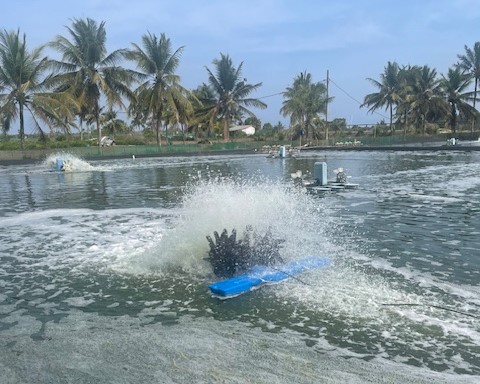
Most shrimp farms depend on diesel-powered aerators, a device that mixes air with water to make a smooth stream through a faucet. Aerators are crucial for shrimp farms because they help maintain optimal water quality and oxygen levels, which directly impact shrimp health and growth. Conventional aerators not only contribute to greenhouse gas (GHG) emissions, but they also drive up operational costs. In addition, poor water quality management leads to uncontrolled dissolved oxygen levels, causing high shrimp mortality rates and inefficient resource use. As the aquaculture sector rapidly expands, these challenges pose significant threats to environmental sustainability and food security.
Despite these pressing issues, there remains a gap in commercial solutions tailored to the needs of small and medium-sized shrimp farmers. There is a demand for cost- and energy-efficient technology that effectively manages water parameters like oxygen levels.
Crustea’s Eco-Aerator addresses this gap by offering a solar-powered solution that reduces energy consumption by up to 80% while effectively managing water quality. The device can be purchased through direct sales and leasing agreements. Crustea offers Platform-as-a-Service or Software-as-a-Service models for water quality and energy management. By improving shrimp productivity and minimizing environmental impact, Crustea’s solution represents a significant advancement in sustainable aquaculture, helping farmers lower costs while adopting eco-friendly practices.
By deploying Crustea’s solar-powered Eco-Aerators and IoT monitoring systems, the partnership aims to significantly reduce operational costs and greenhouse gas emissions while boosting farm productivity by up to 200%. To scale up, Su-re.co will train over 1,000 farmers in sustainable practices to adapt to climate change impacts through its Climate-Resilient Farmer Field Schools (CR-FFS) and advocate for policy changes.
To date, the partnership has made strong progress in implementing a scalable, climate-aligned aquaculture model. su-re.co successfully identified ten high-potential locations across Indonesia for the implementation of Climate-Resilient Farmer Field Schools (CR-FFS), through joint research activities with Crustea and a series of stakeholder engagements conducted with support from the Indonesian Ministry of Marine Affairs and Fisheries (KKP) and the Ministry of Energy and Mineral Resources (ESDM).
Consultations with provincial governments and relevant ministries confirmed strong early alignment and readiness to move into implementation. Bali has been selected as the pilot location for the CR-FFS, supported by provincial governments, to serve as a demonstration platform for farmer training, field validation, and adoption of climate-resilient and low-emission shrimp farming practices. In parallel, national-level consultations — including with the Ministry of Villages — indicated interest in exploring pathways to connect CR-FFS with broader community development and food and nutrition priorities, including the Makan Bergizi Gratis national programme.
Crustea supplied baseline environmental performance data, while su-re.co initiated the development of an ESG-aligned Life Cycle Assessment (LCA) framework capturing energy use, emissions, nutrient pollution and water consumption across the shrimp value chain. This work marks an important step toward formalizing Crustea’s sustainability strategy and strengthening preparedness for future investors and regulatory expectations.
R&D efforts continued with Crustea upgrading its EBII IoT water-quality monitoring system, improving pH and salinity sensors, updating the farmer dashboard and initiating exploratory research on AI-based disease detection. Preparations are underway to ensure the technology demonstration supports both training and validation of environmental impacts. The company is also prioritizing women’s empowerment by strengthening their skills and supporting the creation of value-added products from shrimp waste, generating new income opportunities and jobs for women.
To advance investment readiness and explore regional scaling opportunities, Crustea actively leveraged the 2025 P4G Vietnam Summit to conduct site visits to shrimp farms in Vietnam and have discussions with academic partners to better understand market potential in the region.
The partnership comprises the following partners: Crustea (lead business partner); su-re.co (lead administrative partner).
Partners