Forestwise – Yayasan Rimba Raya Abadi
About
The Forestwise – Yayasan Rimba Raya Abadi partnership scaled rainforest products such as illipe butter that created an economic incentive for protecting Borneo’s rainforest in a way that empowered local communities to protect the remaining rainforest.
Investing in Impact
P4G awarded the partnership US $455,000 in grant funding.
Global demand for cocoa butter equivalents is growing due to the need for more sustainable, reliable, and traceable alternatives, especially in response to market volatility and supply chain concerns in some cocoa-producing regions.
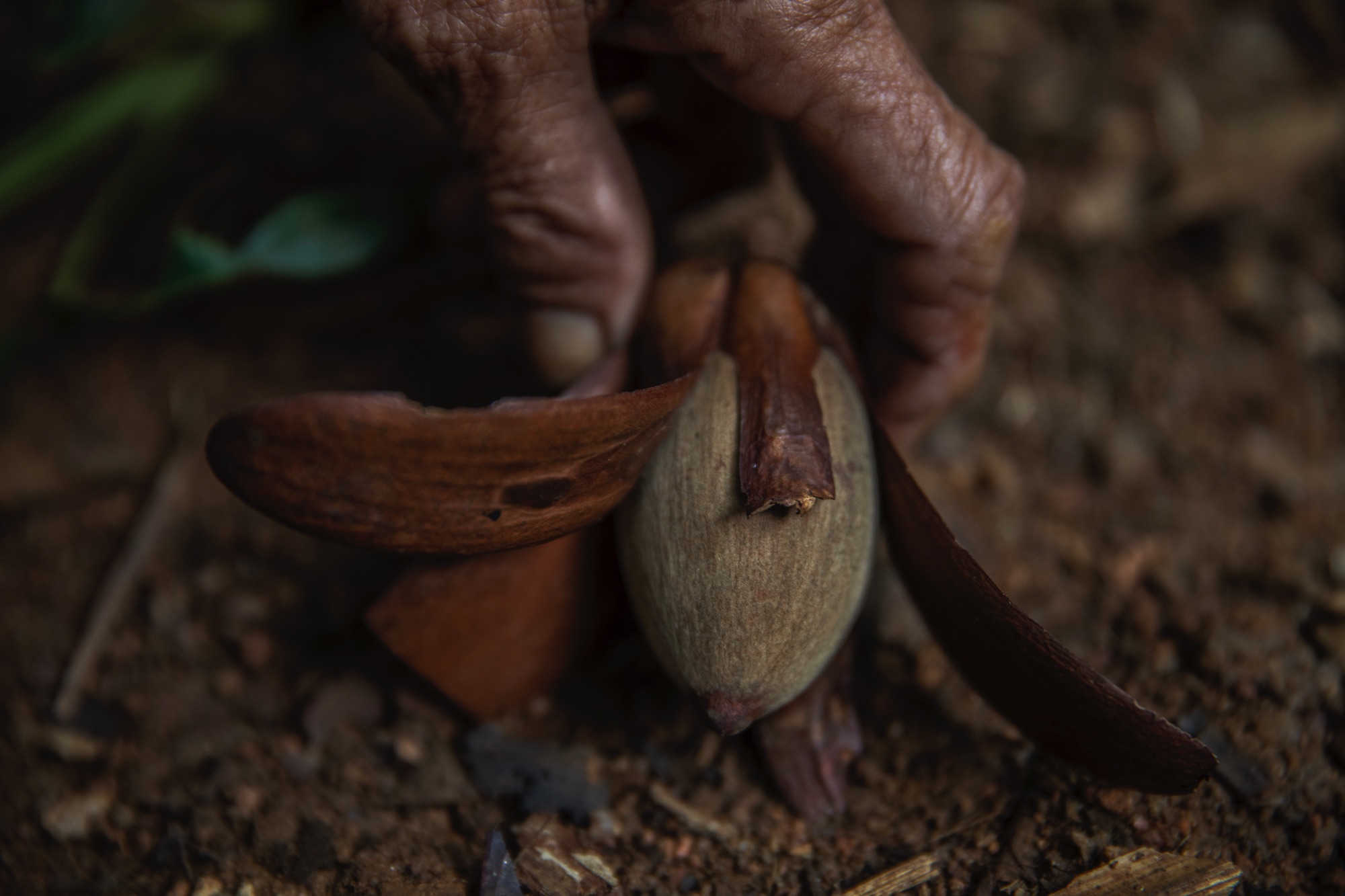
Illipe butter is a cocoa butter equivalent with a neutral color and scent, a higher melting point and rich moisturizing properties. This makes it ideal for personal care and cosmetic products such as soaps, lip balms and lotions. In the food industry, illipe butter can be used in confectionery products like chocolate bars, nutrition bars and ice cream.
Forestwise sustained the rainforests of Borneo by producing products that grow and wild harvested in the rainforest such as illipe butter. By creating value in sustainable forest grown products, the startup made it more profitable to conserve the forest rather than cut it down. This is a priority for Indonesia with the Sintang, West Kalimantan region already experiencing 77% tree cover loss from 2013 to 2021.
Forestwise harvested and processed illipe nuts that grow in the rainforests of West Kalimantan. The wild harvested nuts are collected when they fall from the tree by the native Dayak community. They are processed in a local Forestwise facility and further refined to produce RBD (Refined, Bleached, and Decolorised) illipe butter. Forestwise products are fully certified including FFL, EU Organic, USDA Organic, COSMOS, and Halal.
Key achievements during the P4G grant period between 2024 – 2026:
- Contributed to the protection of about 273,423 hectares of forest
- Secured more than US $91,500 in non-commercial funding
- Formalized almost 2,000 long-term farmer contracts and trained about the same number across 99 villages on sustainable harvesting, agroforestry and financial management
- Achieved B Corps and EarthKosher certification
- Signed an MOU with the provincial government of Kalimantan alignment private sector operations with public forest management.
Land tenure was a foundational pillar for Forestwise’s business model, and the startup conducted a detailed mapping to understand ownership conditions and evaluate the potential for value chains and carbon restoration. As part of the process the startup mapped more than 10,000 hectares of land and provided guidance for land ownership schemes and continued implementation. In tandem, the startup prioritized capacity building of farmers so they could continue to be active forest stewards. Forestwise trained about 1,800 farmers across 99 villages and results showed a high uptick of knowledge transfer of complex agroforestry concepts and financial planning with 40% actively cultivating non timber forest products such as Kukui, natural rubber and Arenga. Formal procurement contracts resulted on a direct-to-farmer illipe nut sourcing rate of 85.4%, which amounted to 211 tons of the 247 tons procured in 2025. This injected nearly US $140,000 into local village economies.
Forestwise successfully operationalized a digital traceability dashboard that included mapping the lands of all registered farmers. The startup also continued to update processing technology to minimize its carbon footprints. This included setting measurable reduction targets at the factory level and monitoring emissions, water use and waste management; operationalizing a fully solar drying system at village level; and repurposing 100% of illipe waste into animal feed and other uses.
Forestwise shaped the enabling environment for sustainable forest products through several engagements and collaboration. The startup worked with the Department of Environment and Forestry at the provincial level to align forest management activities and establish shared accountability for land use. It also cultivated strategic partnerships with local, national and global organizations to build trust and advance scaling at multiple levels. These collaborations helped Forestwise unlock operational capital and technical assistance including funding from the Dutch government through RVO for improving living wages and incomes for farmers and supporting product diversification.
Forestwise worked with IDH (Sustainable Trade Initiative) to explore the benefits of a diverse vs. monocultural rainforest and carbon credit opportunities. The study showed that maintaining diverse rainforest ecosystems generates higher long-term benefits for conservation, biodiversity and socio-economic welfare of local communities. Forestwise disseminated the results through a national-level seminar, convening local, district, provincial, and national stakeholders, including relevant government agencies.
During the P4G funding period, Forestwise explored product and market diversification including engaging with P4G grantee MYCL to research the use of illipe waste in sustainable mushroom leather fabrics, and speaking with global tire manufacturers to enter the natural rubber market.
As part of prudent customer management to balance the rising illipe butter demand against limited supply, Forestwise prioritized long-term strategic accounts and established a pre-payment partnership with Lush that strengthened its working capital and enabled early procurement from farmers.
Forestwise also actively participated in prominent trade shows to cement its status as a globally recognized investment ready leader in sustainable non-timber forest products.
Key lessons learned
- Market demand can outpace operational readiness faster than anticipated and scaling supply, infrastructure and processing capacity must be aligned to meet the surge in demand.
- Control over upstream supply chains such as farmer engagement, harvesting systems and landscape mapping is non-negotiable for sustainability-driven businesses to ensure traceability and supply reliability.
- R&D is a strategic growth driver that needs to be deployed in a targeted manner to strengthen global competitiveness.
- Diversification across NTFPs is essential for both resilience and growth.
- Strategic partnerships are force multipliers for scale and credibility, enable capital and network access that would not otherwise be achievable.
Forestwise produced the following knowledge products
- Lessons Learned From the Forestwise-P4G Partnership on Enhancing Rainforest Value
- Lesson Learned for Natural Rubber/Latex: Analysis and its Opportunities in Forestwise Collection Area
- Lesson Learned for Arenga Pinnata: Analysis and its Opportunities in Forestwise Collection Area
- Integrating #RainforestValue into Multi-Forest Business and Non-Timber Forest Products (NTFP) Management: Closing Policy Gaps for a Forest-Based Green Economy in West Kalimantan
Yayasan Rimba Raya Abadi supported Forestwise in training farmers and developing knowledge product to help them understand their land ownership rights.
The partnership comprised the following partners: Forestwise (lead business partner); Yayasan Rimba Raya Abadi (lead administrative partner).
Partners